

Short on Time? Medications for Opioid Use Disorder in the Criminal Justice System Explained
- Why are correctional facilities such a critical opportunity to address opioid use disorder? Nearly one in five individuals in the criminal justice system (CJS) meet the criteria for opioid use disorder (OUD), making jails and prisons one of the most important touchpoints for intervention.1
- What are the biggest barriers to providing medications for opioid use disorder (MOUD) or OUD care in jails and prisons? Nearly 50% of U.S. jails cite inadequate staffing as the primary barrier to offer MOUD. For facilities facing workforce shortages, LAIs offer a practical, evidence-based solution that also improves patient outcomes. 5
- How can correctional facilities reduce the time and cost of delivering MOUD? Long-acting injectable buprenorphine has the lowest total monthly carceral staffing time and cost among MOUD options, reducing staffing burden and operational complexity for correctional facilities.1,5,6,7
Medications for Opioid Use Disorder in the Criminal Justice System
Medications for opioid use disorder (MOUD) can protect communities, reduce recidivism, and save taxpayer dollars when they are effectively used in jails and prisons.
Administering MOUD in correctional settings matters because:
- Nearly one in five individuals meets the criteria for opioid use disorder (OUD) in the criminal justice system (CJS), making correctional facilities one of the most important touchpoints for intervention.1
- There’s a 40x higher overdose risk for individuals leaving incarceration in the first two weeks post-release — a critical and actionable window.2
- $52 billion is the annual taxpayer cost of the cycle of addiction, re-arrest, and re-incarceration when MOUD treatment is not provided. This ends up costing about $44,000 per inmate. 3
- Less than 10-20% of eligible incarcerated individuals receive FDA-approved MOUD, even where treatment programs exist, representing a significant untapped opportunity to address the cycle of repeated arrests and save lives.1
Recognizing that change is needed, the momentum is building at the federal and state levels to introduce and support policies that prevent overdose, reduce recidivism, fund public health initiatives, and address the challenges correctional leaders face. Nearly 50% of U.S. jails cite inadequate staffing as the primary barrier to offer MOUD. For facilities facing workforce shortages, LAIs offer a practical, evidence-based solution that also improves patient outcomes. 5
- A growing number of states are expanding MOUD access in correctional settings, driven by strong evidence of reduced recidivism and lower costs.
- The SUPPORT Act was reauthorized in December 2025 with overwhelming bipartisan support, renewing billions in federal funding for overdose prevention and treatment, including in correctional settings.
- Federal grant programs like the Comprehensive Opioid, Stimulant, and Substance Use Program (COSSUP) continue to fund public health and public safety partnerships, and these programs have maintained support across three administrations.
- Facilities adopting long-acting injectable (LAI) buprenorphine report simplified operations, reduced contraband risk, and calmer housing environments, addressing real-world challenges correctional leaders face every day. 1,5,6,7
Nearly 50%
of U.S. jails cite inadequate staffing as the primary barrier to offering MOUD.5
For facilities facing workforce shortages, LAIs offer a practical, evidence-based solution that also improves patient outcomes.
What is Long-Acting Injectable (LAI) Buprenorphine and How Can it Fit into Correctional Care
LAI buprenorphine is a next-generation formulation that works over an extended period of time without requiring daily doses — reducing carceral staffing burdens and operational complexity for correctional facilities.1,5,6,7 LAI buprenorphine provides a flexible treatment option for patients that yield stability and a return to normalcy by not having to visit treatment centers every day.7
LAIs can help address the strain on jails and prisons by reducing staffing and resource needs. They:
- Simplify administration by replacing daily dosing with weekly or monthly injections, easing logistical processes.6,8,9,10,11
- Lower the risk of diversion, since medication is not stored or handled by patients.7,12
- Improve retention and adherence to medication, by ensuring continuous medication coverage, even during custody transitions or release.12,13
- Reduce the risk of overdose by maintaining therapeutic medication levels during the high-risk community re-entry period.9,11,12
- Support positive re-entry outcomes by helping individuals maintain stability, find employment, and avoid returning to jail or prisons.7,12
- Save carceral facilities up to $295,000 per patient by decreasing staffing needs and downstream behavioral therapy, healthcare, and justice system utilization.3
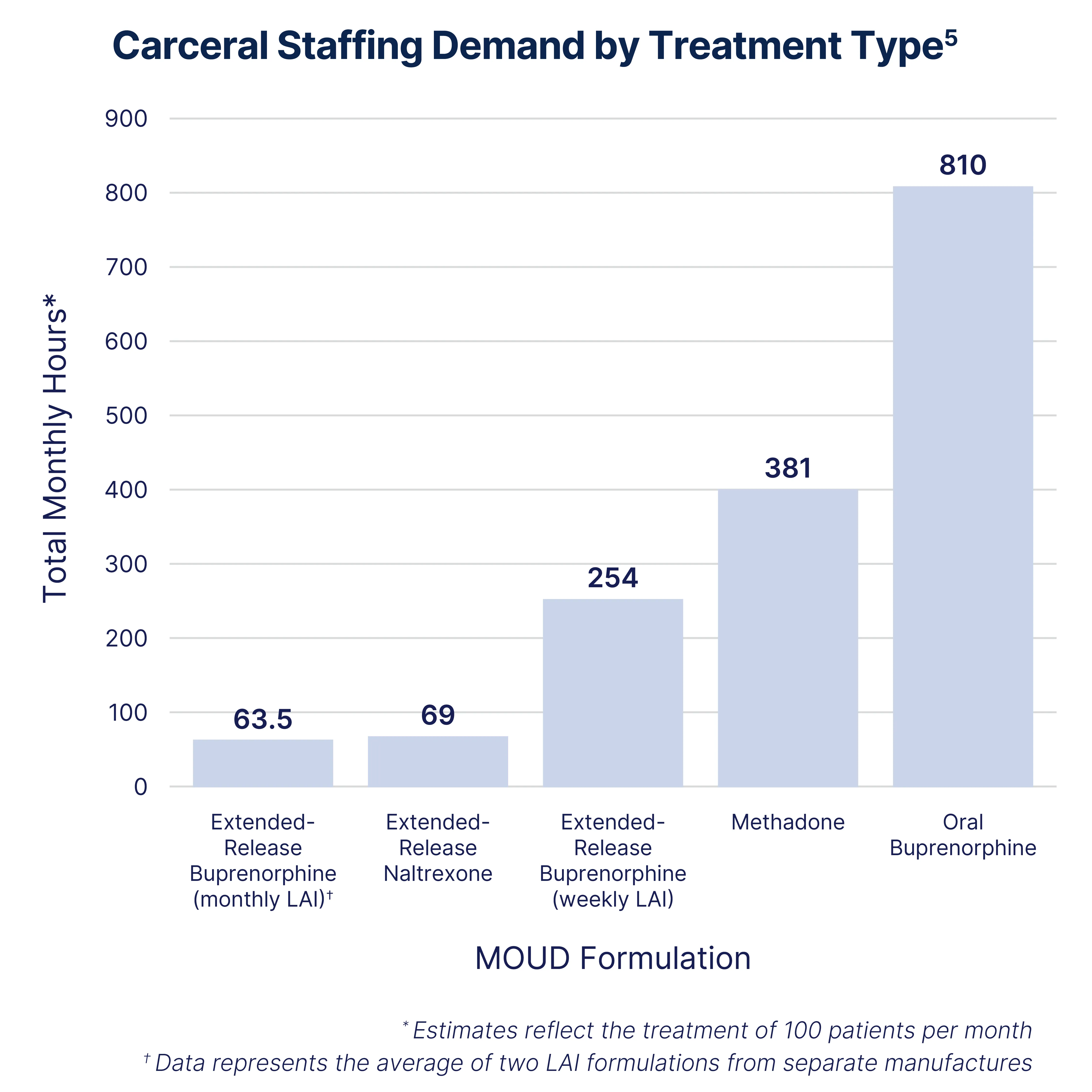
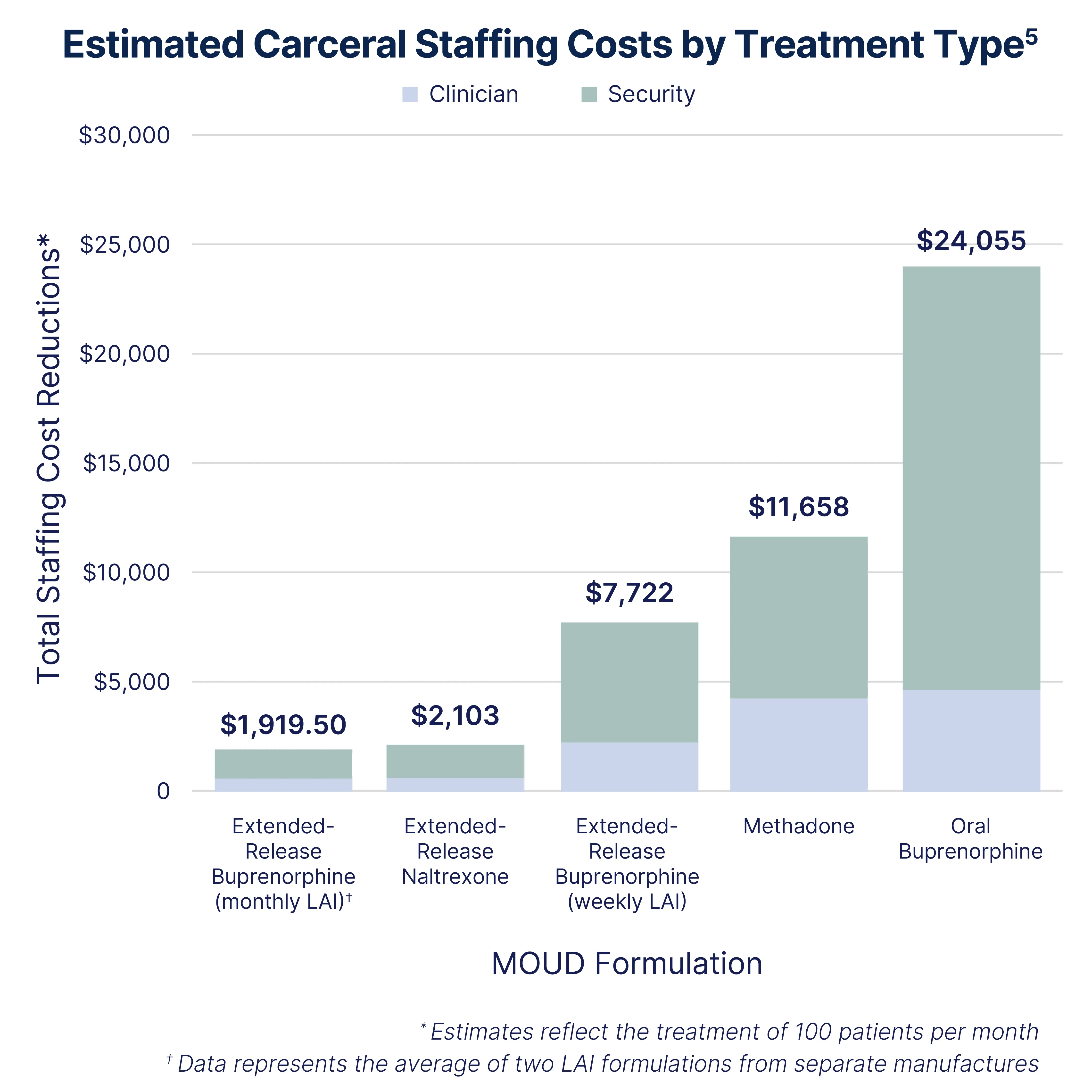
Cost savings from long-acting treatment can be reinvested into patient care, potentially expanding access to opioid use disorder treatment while reducing system strain over time and lowering recidivism.
References
- Wolfe, C., Gaiazov, S., Valera, P., Mullen, W., MacDonald, R., & Heidbreder, C. (2026). Medications for opioid use disorder in correctional facilities: A 2022 cross-sectional survey of Health Care Staff. Journal of Correctional Health Care. https://doi.org/10.1177/10783458251406288
- Ranapurwala, S., Shanahan, S., Alexandridis, A., Proescholdbell, S., Naumann, R., Edwards, D., & Marshall, S. (2018). Opioid Overdose Mortality Among Former North Carolina Inmates: 2000–2015. American Journal of Public Health. https://doi.org/10.2105/AJPH.2018.304514
- 3. Avalere Health. “The Cost of Opioid Use Disorder.” AvalereHealth.com, May 19, 2025. https://advisory.avalerehealth.com/insights/white-paper-the-cost-of-opioid-use-disorder
- Legislative Analysis and Public Policy Association, “MAT in Correctional Settings.” https://legislativeanalysis.org/knowledge-lab-state-maps/mat-in-correctional-settings/
- Poole, C., Flynn, C., Kistler, K., Chaplin, S., Van Stiphout, J., Carlton, R., Thompson, M., Jay, J., & Mullen, W. (2026). Staffing Resource Use: Medications for Opioid Use Disorder Cost Impact Model in Carceral Facilities. Journal of Current Medical Research and Opinion. https://cmro.in/index.php/jcmro/article/view/1156
- ScienceInsights. “How Do Long-Acting Injectable Medications Work?” Science Insights, Nov. 16, 2025. https://scienceinsights.org/how-do-long-actinginjectable-medications-work/
- Nordgren, J., et al. “Healthcare staff’s perspectives on long-acting injectable buprenorphine treatment: a qualitative interview study.” Pub Med Central, April 5, 2024. https://pmc.ncbi.nlm.nih.gov/articles/PMC10996245/
- Allen, Susie. “Within Reach.” The University of Chicago Magazine, Summer 2024, https://mag.uchicago.edu/science-medicine/within-reach
- Huxley-Reicher, Z., et al. “Extending Knowledge of LAI Buprenorphine with Dr. Ken Lee.” The Curbsiders Addiction Medicine Podcast, August 31, 2023. https://thecurbsiders.com/addiction-medicine-podcast/20-extending-knowledge-of-lai-buprenorphine-with-dr-ken-lee
- Allen, E., et al. “Exploring patient experience and satisfaction with depot buprenorphine formulations: A mixed-methods study.” Drug and Alcohol Review, Feb. 14, 2023. https://onlinelibrary.wiley.com/doi/10.1111/dar.13616
- Washington State Health Care Authority. “Recommendations on alternative models for long-acting injectable buprenorphine.” Washington State Health Care Authority, Oct. 15, 2024 https://www.hca.wa.gov/assets/program/long-acting-injectible-buprenorphine-leg-report-2024.pdf
- Flanagan, E., et al., “Barriers to Universal Availability of Medications for Opioid Use Disorder in US Jails.” JAMA Network Open, April 16, 2025. https://jamanetwork.com/journals/jamanetworkopen/fullarticle/2832851
- Lee, Joshua D., et al. “Comparison of Treatment Retention of Adults with Opioid Addiction Managed with Extended-Release Buprenorphine vs Daily Sublingual Buprenorphine-Naloxone at Time of Release from Jail.” JAMA Network Open, Sept. 8, 2021. https://jamanetwork.com/journals/jamanetworkopen/fullarticle/2784022
Share