

Short on Time? Long-Acting Injectable Buprenorphine Treatment Explained
- What is long-acting injectable buprenorphine? Long-acting injectable (LAI) buprenorphine is a medication used to treat opioid use disorder (OUD). It is a monthly or weekly shot that releases buprenorphine over an extended period of time, helping keep a steady amount of medicine in the body without needing to take it every day.1,2
- What are the benefits of LAIs? LAIs help manage OUD by improving treatment retention, reducing the burden of daily doses or clinic visits, blocking the rewarding effects of opioids, and lowering the risk of diversion. They can also lower costs by decreasing overdose rates, hospital stays, and repeat involvement within jails and prisons.1,2,3,4,6,7,8,9
Long-Acting Injectable Buprenorphine Treatment for Opioid Use Disorder Explained
Long-acting injectable (LAI) buprenorphine is a medication formulation used to treat opioid use disorder (OUD) that releases buprenorphine over an extended period of time, helping keep a steady amount of medication without needing to take it every day.1,2
LAIs support OUD treatment by:
- Reducing the burden of daily doses and clinic visits 1,3,7
- Blocking the rewarding effects of opioids, including fentanyl8
- Enabling long-term disease management vs. crisis-based care1,2,3,4
- Lowering healthcare costs by decreasing overdose rates, hospitalizations, and recidivism5
- Improving treatment retention1,4,6
- Reducing risk of diversion in criminal justice system settings (when medication is taken by someone other than whom it is prescribed)2,9
Individuals and Communities Benefit from Using LAIs as a Primary Care Option
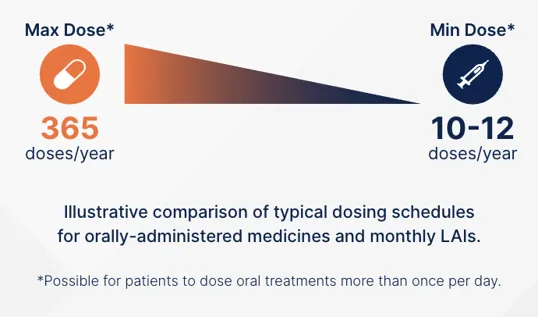
The burden of taking a medicine each day can be greatly reduced with weekly or monthly LAIs.3 In fact, people living with OUD are more likely to stay on treatment and express higher satisfaction when taking LAIs compared to daily medications.4,7,10
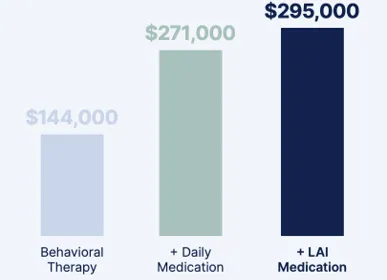
Research also shows that when medications for opioid use disorder (MOUD) are combined with behavioral therapy, healthcare costs go down. The savings are even larger when long-acting treatments are paired with behavioral therapy, saving as much as $295,000 per patient annually.11
In short, improving access to long-acting injectable buprenorphine helps both public health outcomes and a person’s chances for long-term recovery.
References
- ScienceInsights. “How Do Long-Acting Injectable Medications Work?” Science Insights, Nov. 16, 2025. https://scienceinsights.org/how-do-long-acting-injectable-medications-work/
- Nordgren, J., et al. "Healthcare staff's perspectives on long-acting injectable buprenorphine treatment: a qualitative interview study." Pub Med Central, April 5, 2024. https://pmc.ncbi.nlm.nih.gov/articles/PMC10996245/
- Allen, Susie. “Within Reach.” The University of Chicago Magazine, Summer 2024. https://mag.uchicago.edu/science-medicine/within-reach
- Compton, Wilson M., and Volkow, Nora D. “Extended-Release Buprenorphine and Its Evaluation With Patient-Reported Outcomes.” JAMA Network Open, May 10, 2021. https://jamanetwork.com/journals/jamanetworkopen/fullarticle/2779757
- Huxley-Reicher, Z., et al. “Extending Knowledge of LAI Buprenorphine with Dr. Ken Lee.” The Curbsiders Addiction Medicine Podcast, August 31, 2023. https://thecurbsiders.com/addiction-medicine-podcast/20-extending-knowledge-of-lai-buprenorphine-with-dr-ken-lee
- Lee, Joshua D., et al. “Comparison of Treatment Retention of Adults with Opioid Addiction Managed with Extended-Release Buprenorphine vs Daily Sublingual Buprenorphine-Naloxone at Time of Release from Jail.” JAMA Network Open, Sept. 8, 2021. https://jamanetwork.com/journals/jamanetworkopen/fullarticle/2784022
- Allen, E., et al. “Exploring patient experience and satisfaction with depot buprenorphine formulations: A mixed-methods study.” Drug and Alcohol Review, Feb. 14, 2023. https://onlinelibrary.wiley.com/doi/10.1111/dar.13616
- Shiwach, R., et al., “Comparison of Extended-Release Buprenorphine Doses for Treating High-Risk Opioid Use.” JAMA Network Open, Dec.17, 2025. https://jamanetwork.com/journals/jamanetworkopen/fullarticle/2842881
- Flanagan, E., et al., “Barriers to Universal Availability of Medications for Opioid Use Disorder in US Jails.” JAMA Network Open, April 16, 2025. https://jamanetwork.com/journals/jamanetworkopen/fullarticle/2832851
- Kuhns, Lisa. “Long-Acting Injectable Antipsychotics Reduce 30-Day Rehospitalizations.” Psychiatry Advisor, Feb. 27, 2024. https://www.psychiatryadvisor.com/news/long-acting-injectable-antipsychotics/
- Avalere Health. “The cost of addiction: Opioid use disorder in the United States.” Avalere Health, May 2025. https://advisory.avalerehealth.com/wp-content/uploads/2025/05/Avalere-Health-White-Paper_The-cost-of-opioid-addiction_OUD-in-the-United-States.pdf
Share